
What does it mean and what should I do? "Check Hybrid System" / "Hybrid System Malfunction" dashboard warning in a Toyota, Lexus, Prius, Camry Hybrid, Highlander Hybrid, RAV4 Hybrid, etc.
What it means
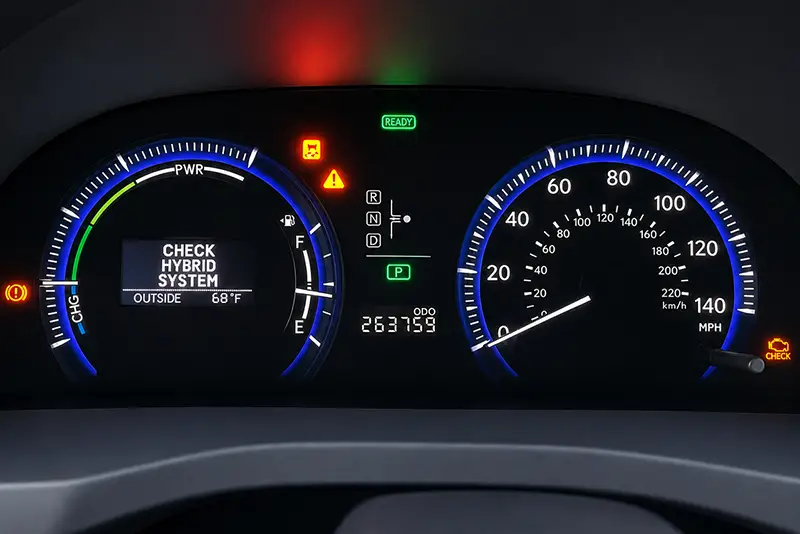
"Check Hybrid System" means the car's hybrid-control computer has detected a fault somewhere in the hybrid powertrain or in a system that affects it. It does not automatically mean the big hybrid battery is dead. The hybrid system includes the high-voltage traction battery, inverter/converter, motor-generators, transaxle, cooling circuits, control computers, relays, wiring, and safety interlocks. Our hybrid specialists at Illinois Hybrid Service note that the warning can appear even when the actual failed part is not the battery, inverter, or transaxle, and may even be caused by a related engine, ABS, cooling, or sensor fault that triggers a "collateral" hybrid warning.
How serious is it?
Treat it as potentially serious until diagnosed.
Some causes are minor, such as a weak 12-volt battery, blocked hybrid battery cooling vent, blown fuse, or loose/dirty connection. Others are expensive or safety-related, such as inverter failure, high-voltage battery failure, inverter coolant pump failure, isolation faults, or overheating. Illinois Hybrid Service warns that continuing to drive with hybrid electrical faults can lead to reduced power, limp mode, or damage to battery and other components.
The safest general rule is:
If the car drives normally, no overheating symbol is present, and there is no smell, smoke, power loss, or weird noise, you may be able to move on your own risk for a short distance to a safe place or repair shop. But you should not keep using it normally.
If the car says to stop, the vehicle loses power, the engine overheats, the READY light will not come on, or the car will not shift/drive normally, stop safely and tow it.
What to do immediately
First, look at the full dashboard, not just the words "Check Hybrid System."
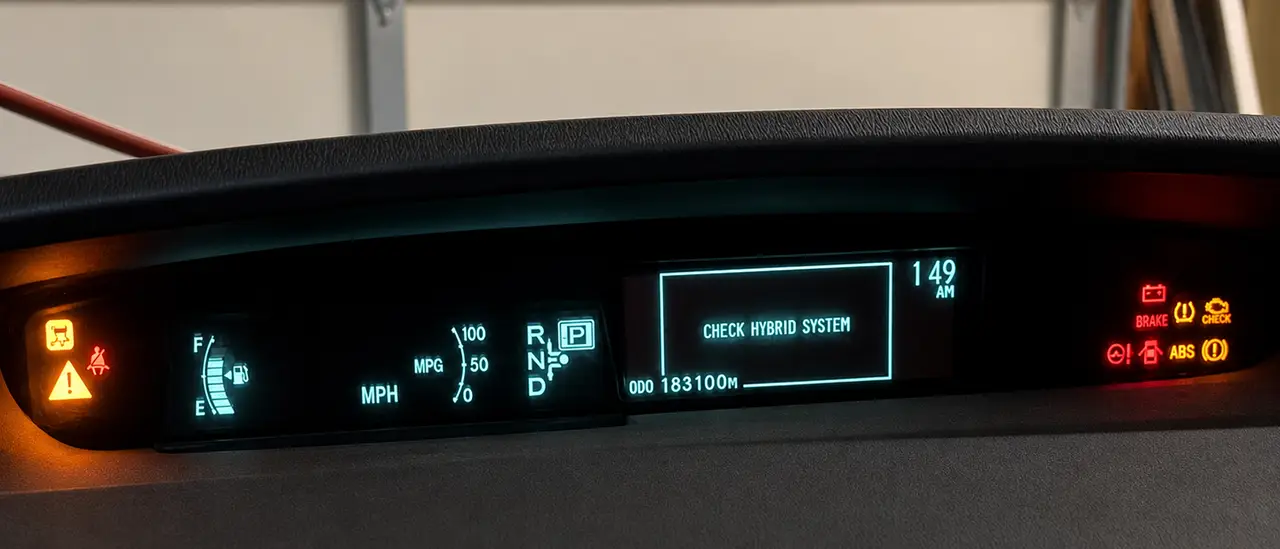
Check for these:
If it is safe, park on level ground, shift to Park, set the parking brake, turn the car off, and wait a minute. Then restart once. If the warning returns, do not keep cycling the car repeatedly; the stored diagnostic codes are what the mechanic needs.
Common causes
Weak or failing 12-volt battery
This is one of the most common "cheap" causes. Hybrids still use a 12V battery to power computers, relays, ECUs, lights, locks, and startup electronics. If the 12V battery is weak, it can cause strange warnings, failed starts, and false-looking hybrid faults.
This is especially likely if:
- You recently left lights on.
- The car sat unused.
- It is cold outside.
- The car has random warning lights.
- The doors, locks, or displays act weak.
- The 12V battery is older than about 4–6 years.
A basic parts-store battery test can help, but hybrids sometimes need the battery tested under proper load. A "12.2V" reading at rest is not enough to prove it is healthy.
Hybrid battery cooling fan or vent blockage
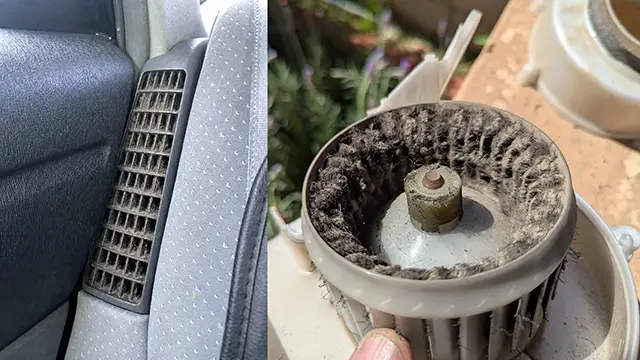
Many Toyota/Lexus hybrids have a cooling intake near the rear seat or cargo area. If the vent is blocked by a towel, pet hair, dust, luggage, or debris, the hybrid battery can overheat and trigger a warning.
This is more likely if:
- You carry pets.
- The rear seat/cargo area has blankets or bags.
- The fan sounds loud.
- The warning appears after long drives, hot weather, hills, or stop-and-go traffic.
- Fuel economy has dropped.
Cleaning the intake may help, but if the fan or internal ducts are clogged, the battery cover may need to be opened by someone familiar with hybrid safety.
Inverter or inverter cooling problem
The inverter converts high-voltage DC battery power into AC power for the motor-generators and also manages electrical flow between the engine, battery, and motors. Inverter cooling is separate from the engine cooling system on some hybrids, and inverter problems can trigger the hybrid warning and power loss.
Symptoms can include:
- Reduced power.
- Warning after driving for a while.
- Whining pump noise missing or abnormal.
- Overheating warnings.
- Car enters limp mode.
On some Toyota/Lexus models, inverter coolant pump failure is a known pattern. This is not something to guess at; the correct diagnostic codes and live data matter.
High-voltage hybrid battery deterioration
The big traction battery can fail or weaken with age, mileage, heat, deep cycling, or module imbalance. A failing hybrid battery may still let the car drive, but the car may run the gasoline engine more often, show rapid battery charge swings, lose fuel economy, or feel sluggish.
Signs include:
- Battery gauge jumps from full to low quickly.
- Fan runs loudly in the back.
- Poor MPG.
- Weak acceleration.
- Engine runs constantly.
- Codes such as P0A80, P0A7F, P3011–P3024, or related battery block codes.
A battery code does not always mean the entire pack must be replaced. Sometimes the issue is cooling, corrosion, a sensor harness, or a weak module. But most hybrid specialists recommend full pack replacement because module-level repairs can be temporary.
Blown fuse, relay, wiring, or safety interlock problem
Hybrids have high-voltage relays, service plugs, interlock circuits, fuses, wiring harnesses, and safety monitoring. A blown fuse or open circuit can trigger the warning.
Possible triggers:
- Recent repair work.
- Rodent damage.
- Water intrusion.
- Jump-start mistake.
- Aftermarket audio/alarm/remote-start installation.
- Loose service plug after battery work.
Engine problem causing hybrid warning
The gasoline engine is still part of the hybrid system. If the engine misfires, overheats, has low coolant, has an EGR issue, has a failed water pump, or cannot produce expected power, the hybrid system may complain because it depends on the engine.
This is why a regular check-engine code can appear alongside "Check Hybrid System."
Brake/ABS/regenerative braking issue
Regenerative braking is integrated with the hybrid system. A fault in ABS, brake actuator, wheel-speed sensors, or brake control can cause hybrid-related warnings. This can be serious because braking behavior may change, even if the car still moves.
Isolation fault / high-voltage leak detection
Hybrids constantly monitor whether high voltage is safely isolated from the vehicle chassis. Water intrusion, damaged insulation, battery corrosion, inverter issues, or A/C compressor faults can trigger isolation codes. P0AA6 is an example code that can be caused by a water leak in a hybrid vehicle.
This can sometimes prevent restart after shutdown. Do not clear these codes casually unless you need to move the car from an unsafe place.
Do not just "reset" it
A lot of people disconnect the 12V battery or clear codes to make the message disappear. Disconnecting the 12V battery or clearing codes may temporarily turn the warning light off and make the vehicle seem like it's running fine. However, this only resets the ECU (vehicle computer) and does not fix the problem.
The warning appears because the car has stored diagnostic data. Illinois Hybrid Service specifically warns that clearing the warning can lead to further damage or unsafe driving conditions, it also erase important diagnostic data, making it harder to properly identify and repair the issue.
What diagnostic scan you need
A generic OBD-II scanner may only show engine codes. For a hybrid warning, you often need a scanner that can read:
Toyota/Lexus Techstream or a high-quality bidirectional scanner is ideal. Some consumer apps can read hybrid battery data on certain Toyota/Lexus models, but they are not a full substitute for professional diagnostics.
Ask the shop for the actual codes, not just "battery bad." Useful examples include:
P0A80replace hybrid battery pack / battery deterioration.P0A7Fhybrid battery pack deterioration.P0AA6high-voltage isolation fault.P0A93inverter cooling system performance.P0A94DC/DC converter performance.P0A92hybrid generator performance.P0AC4hybrid powertrain control module requested MIL.P3000battery control system.The exact meaning depends on year, make, model, subcodes, freeze-frame data, and live readings.
Can you drive it?
Use this decision tree.
Tow it if any of these are true
- Message says stop vehicle.
- READY light is off.
- Car will not shift into Drive or Reverse.
- Car has very low power.
- Engine temperature warning is on.
- Oil pressure warning is on.
- Brake warning/ABS warning is on with abnormal braking.
- You smell burning, see smoke, or hear electrical buzzing/popping.
- The car was in a crash or flood.
- The car shuts off while driving.
Drive only a short distance if all are true
- The car says READY.
- No overheating or oil pressure warning.
- Oil level and coolant level is in proper range.
- Brakes feel normal.
- Acceleration feels normal.
- No smoke/smell/leaks.
- You are going directly to a shop or safe location.
Even then, avoid highways, hard acceleration, hills, and long distances.
Do not keep daily-driving it
Even if it feels fine, the fault may be intermittent. Continuing to drive can turn a small issue into a big one, especially if the cause is cooling-related or inverter-related.
Repair cost ranges
Costs vary wildly by model and cause.
Illinois Hybrid Batteries lists hybrid battery replacement prices for Toyota and Lexus vehicles, ranging from $899 to $2,799 for refurbished batteries and from $2,599 to $4,099 for new OEM batteries, depending on the model and warranty option — 2, 4, or 5 years.
Bottom line
"Check Hybrid System" is a broad warning, not a diagnosis. It can be as simple as a weak 12V battery or blocked cooling vent, or as serious as inverter failure, high-voltage battery failure, overheating, or an isolation fault. The key is do not guess and do not reset first. Decide whether it is safe to drive or whether the vehicle needs towing.
If you are not sure whether your vehicle is safe to drive, Illinois Hybrid Service can help. We specialize in hybrid vehicle diagnostics and repair and have extensive experience working on Toyota and Lexus hybrid vehicles. We can guide you through the next steps.